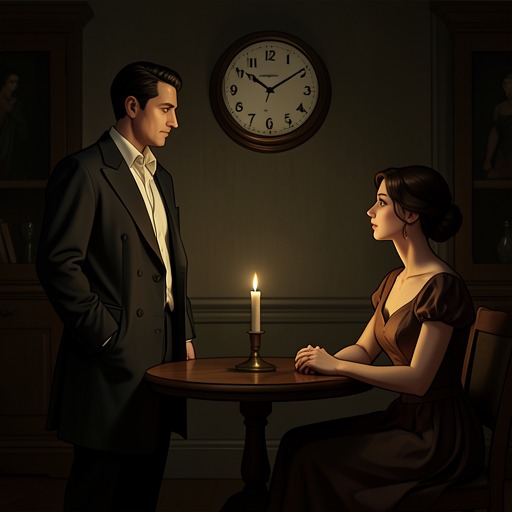
“She is tolerable, but not handsome enough to tempt me”
Just DesertsThe expression “She is tolerable, but not handsome enough to tempt me” is Fitzwilliam Darcy’s public refusal to dance with Elizabeth Bennet at the Meryton Assembly. Spoken after Charles Bingley praises the evening’s women and points out that Elizabeth is attractive and agreeable, it reduces her to a judgment made through male approval. Its decisive force lies in the contrast between Darcy’s handsome exterior and his humiliating conduct: the sentence turns a first encounter into an injury that Elizabeth remembers, interprets, and eventually transforms into a challenge to his character.
Setting and Immediate Context
At the 1811 Meryton Assembly, Elizabeth is already conscious that the local marriage market offers few new possibilities. Meryton is near London, yet not near enough to attract travellers who want the capital, while London residents seeking escape prefer to go farther than southern Hertfordshire. The war on the continent has also reduced the number of eligible men in the district. Elizabeth has danced with men of every degree of eligibility at these assemblies for four years, so the arrival of the Netherfield party gives the evening unusual emotional and social importance.
Elizabeth is twenty years old and approaching her twenty-first birthday. She has just noticed that Darcy is among the most handsome men she has ever seen, and she is mildly embarrassed by the girlish reaction she believes she has outgrown. Her attention then catches the conversation along the back wall. Charles Bingley defends the women present, saying that he has never met so many pleasant girls and that several are unusually pretty. Darcy answers that there is not another woman in the room with whom he would not regard dancing as a punishment. Bingley replies that Darcy is already dancing with the only handsome girl in the room, looking toward Jane Bennet, and then tries to direct his friend toward Elizabeth, whom he calls very pretty and likely agreeable.
Wording and Verbal Violence
Darcy’s sentence has a carefully graded cruelty. “Tolerable” appears to concede that Elizabeth is not entirely unattractive, but the faint praise makes the judgment colder rather than kinder. The second clause converts appearance into a test of temptation: Elizabeth is not merely someone Darcy declines to dance with; she is declared insufficient to command his desire or attention. His additional claim that he is not inclined to give consequence to young ladies slighted by other men makes the remark socially pointed. He presents his refusal as a rational assessment while also treating Elizabeth as beneath the notice that might restore her standing.
The scene is intensified by the physical and social circumstances of its delivery. Elizabeth is aware that Darcy is scrutinizing her even while she keeps her eyes on the dancers. She turns and catches his eye; he looks at her, withdraws his gaze, and utters the dismissal coldly. The statement is therefore not an accidental private impression overheard at a distance. It is part of a public exchange in which Darcy knowingly makes Elizabeth’s value dependent upon his approval. Her blood seems to run cold, and the composure she has learned through years of dealing with Fanny Bennet conceals sadness and anger rather than erasing them.
Elizabeth’s response is inward because the rules of the assembly prevent an immediate public retaliation. She regards Darcy as an arrogant and pompous man whose handsome exterior cannot conceal an unpleasant character, and she asks what kind of gentleman would speak so publicly to a young woman he has scarcely met. The one-word riposte that comes unbidden to her mind is “Vengeance.” That word gives the insult a future tense. It does not announce a literal plan at that moment, but it marks the beginning of Elizabeth’s determination to resist Darcy’s authority and to judge him by his actions rather than by his appearance or rank.
Effects on Elizabeth and Darcy
For Elizabeth, the sentence creates the first and most durable version of Darcy in her imagination. She had thought him the most handsome man she had ever encountered; less than an hour later, he has casually classified her as merely “tolerable.” The reversal teaches her how quickly admiration can become contempt when beauty is filtered through pride and social power. Her anger also protects her from the more vulnerable fact that Darcy’s opinion mattered to her before he gave her reason to resent it.
The insult becomes part of the antagonistic pattern through which Elizabeth and Darcy continue to understand one another. Darcy’s first judgment encourages Elizabeth to read later behavior as further evidence of arrogance, while Elizabeth’s wit and independence make her unusually resistant to the deference he expects. When Darcy later discusses George Wickham, Elizabeth confronts him over having heard a private conversation, assumed that she believed Wickham’s lies, and done nothing to protect people in Meryton from the consequences of Wickham’s conduct. Her rebuke is severe: she calls Darcy arrogant, pompous, disdainful of others’ feelings, and no gentleman. She leaves without attempting a curtsey, while Darcy is stunned and fascinated by a woman unlike anyone he has known.
The connection between the assembly insult and the later Wickham conflict is structural as well as personal. At the assembly Darcy dismisses Elizabeth without knowing her; later he assumes that she has accepted Wickham’s account without knowing her judgment. In both cases, he mistakes his own interpretation for knowledge. The first error is expressed as aesthetic discrimination, the later one as social and moral condescension. Elizabeth’s anger therefore addresses more than an unpleasant sentence: it challenges Darcy’s habit of converting limited observation into authoritative verdict.
Revaluation and Narrative Significance
The expression remains powerful because the story later places it beside evidence that exposes the incompleteness of first impressions. Elizabeth learns that Wickham has ruined more than ten women and has fathered three children by three different mothers, while the Darcy family has long excused, concealed, and enabled his behavior. Wickham’s death by drowning leaves Elizabeth wrestling with the conflict between law, religious upbringing, and what she understands as natural justice. The old impulse toward “Vengeance” thus returns in a world where moral responsibility cannot be settled by social appearance alone.
Darcy also undergoes a related process of revaluation. His concern for Georgiana Darcy becomes visible when he reads Caroline Bingley’s letter to Jane Bennet and discovers that its contents could have exposed his innocent sister to devastating consequences. The letter is worse than the current gossip, and Darcy must suppress his anger before responding. This later scene contrasts sharply with his first public dismissal of Elizabeth: the man who once made a rapid judgment about a woman’s attractiveness is increasingly forced to confront the consequences of judgments, concealments, and failures of protection.
As an expression, the sentence therefore functions as a compact record of social power, gendered evaluation, and mistaken perception. It gives Darcy’s pride a memorable verbal form, gives Elizabeth a grievance that can be revisited as her understanding develops, and prepares the movement from visual judgment to moral knowledge. Its apparent finality is precisely what the wider narrative disproves. Elizabeth is not fixed by Darcy’s first assessment, and Darcy is not fixed by the worst implications of his first words; the plot’s emotional work consists in making both characters revise the identities they assigned to one another at the assembly.